
Have you noticed dark patches appearing on your cheeks, forehead, or upper lip during or after pregnancy?
Melasma is a common form of acquired hyperpigmentation that often appears as symmetrical brown or grayish patches on the face. Hormonal changes, including those that occur during pregnancy, can contribute to melasma, while sun and light exposure, genetics, and skin type may
also play a role.
The important thing to know is that melasma can often be improved, but it may return.
Managing it usually requires more than a single brightening treatment it involves identifying triggers, choosing an appropriate treatment plan, and maintaining the results over time.
5 Things You Should Know About Post-Pregnancy Melasma
1. Melasma is not simply a superficial dark spot.
It can involve increased activity of melanocytes, the cells responsible for producing melanin, so
treatment needs to address pigmentation appropriately.
2. Hormones are not the only factor.
Pregnancy can trigger melasma, but sunlight, visible light, genetics, and other factors may also
contribute.
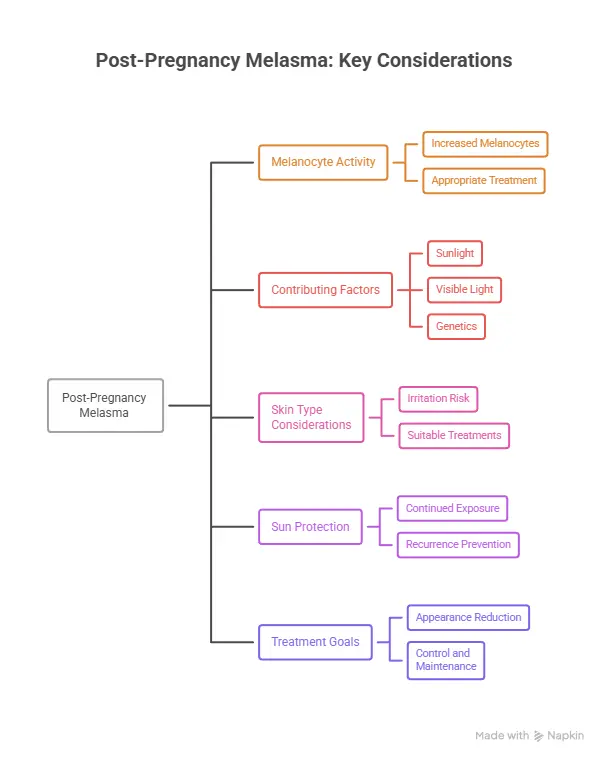
3. Darker skin types may require extra care.
Irritation from an overly aggressive or unsuitable treatment may increase pigmentation in some people.
4. Sun protection is part of treatment.
Even after pigmentation improves, continued exposure to sunlight and light may contribute to recurrence.
5. The goal is not always permanent removal.
A more realistic goal is to reduce the appearance of melasma, control it, and maintain
improvement for as long as possible.
What Exactly Is Melasma?
Melasma is an acquired disorder of skin pigmentation.
It usually appears as symmetrical dark patches on areas of the face such as:
• The cheeks
• The forehead
• The upper lip
• The nose
• Other facial areas
It develops when melanocytes become more active and produce increased amounts of melanin.
But why does this happen?
Melasma usually does not have just one cause.
Several factors may interact, including:
Hormonal changes + sun and light exposure + genetic predisposition + skin type.
Why Does Melasma Appear During Pregnancy?

Pregnancy causes significant hormonal changes in the body.
These changes may affect melanocyte activity, which is why some women notice new dark
patches or increased pigmentation during pregnancy.
This is why melasma is sometimes called the “pregnancy mask.”
After delivery, pigmentation may gradually become less noticeable in some women.
However, melasma can persist in others, particularly when triggers such as sun exposure remain present or when there is an underlying predisposition to pigmentation
Is Every Dark Spot After Pregnancy Melasma?
No.
This is an important distinction.
Not every dark patch that appears after pregnancy is necessarily melasma.
Other forms of pigmentation can occur following inflammation, acne, skin irritation, or other causes.
That is why appropriate treatment starts with identifying the type of pigmentation first.
This matters because a treatment that is suitable for one type of pigmentation may not be
appropriate for another
Why Can Melasma Be Difficult to Treat?
Melasma can be a recurring condition.
The pigmentation may improve for a period of time and then become more noticeable again.
This does not necessarily mean that treatment has “failed.”
New or ongoing triggers may contribute to recurrence, including:
• Sun exposure.
• Light exposure.
• Hormonal changes.
• Skin irritation.
• Inconsistent home care.
• Using unsuitable skincare products.
For this reason, melasma often requires long-term management, rather than focusing only on short-term skin brightening.
Frequently Asked Questions About Post- Pregnancy Melasma and Cosmelan
Q1:Does Pregnancy Melasma Go Away After Delivery?
A: It may improve in some women, but it can persist in others. Hormonal changes, sun
exposure, skin type, and other factors can influence how long the pigmentation remains.
Q2: Does Cosmelan Permanently Remove Melasma?
A: Permanent removal cannot be guaranteed. Treatment may improve the appearance of
pigmentation in some patients, but recurrence remains possible.
Q3:Can Cosmelan Be Used on Darker Skin?
A: It may be appropriate for some patients, but careful assessment and protocol selection are important. The goal is to improve pigmentation while minimizing unnecessary irritation.
Q4:Can Melasma Be Treated While Breastfeeding?
A: It depends on the ingredients included in the treatment protocol. The professional and home- care products should be reviewed with a physician before treatment begins.
Q5:Can I Wear Makeup After Treatment?
A: It depends on your skin condition and your physician’s instructions. If the skin is irritated or peeling, you may be advised to avoid certain products until the skin barrier has recovered.
Q6: Do I Still Need Sunscreen After Melasma Improves?
A: Yes. Sun protection remains important even after pigmentation improves. Environmental triggers can contribute to recurrence.
Q7: Does Every Dark Facial Spot Need Cosmelan?
A: No. Treatment should depend on identifying the type and cause of pigmentation first, followed by selection of the appropriate treatment plan
The Bottom Line: Managing Melasma Starts With Understanding the Cause
Post-pregnancy melasma can be associated with hormonal changes, but it is not simply a
hormonal condition.
Sun exposure, visible light, skin type, genetic predisposition, and skin irritation can all
influence pigmentation and its recurrence.
That is why the best starting point is not necessarily searching for the “strongest brightening
cream” or the “fastest treatment.”
It is understanding the pigmentation, assessing the skin, and building an appropriate
treatment and maintenance plan.
At Everlast Wellness Medical Center in Abu Dhabi, pigmentation treatment begins with an
assessment of the skin and the nature of the concern before an appropriate protocol is selected.
The goal is not simply to make the skin look lighter, but to develop a thoughtful approach to managing pigmentation while supporting the skin barrier and reducing factors that may
contribute to recurrence.
Individual results may vary. Consultation required.