

You may look in the mirror every day and feel like your skin looks better.
Then, on another day, you may feel that your skin looks tired or different.
And that’s completely normal.
Your skin can be affected by many factors, including your daily routine, sleep, stress, environment, and the care you provide.
But this raises an important question:
How can you know whether your skin is actually changing and improving over time?
Relying only on how you feel or what you notice in the mirror isn’t always enough.
That’s where the Progress feature in SkinTrix 360 comes in.
What Is Progress?
Simply put, Progress helps you track changes in your skin over time by looking at the results of your different Skin Scans.
Instead of looking at one result and stopping there, you can follow the changes that appear across a period of time.
So instead of asking:
“What does my skin look like today?”
You can ask:
“How has my skin changed since I started tracking it?”
That’s an important difference.
A single analysis gives you a snapshot of your skin at a specific moment.
Tracking your results over time can give you a broader view of changes and trends.
Why Is Tracking Progress Important?
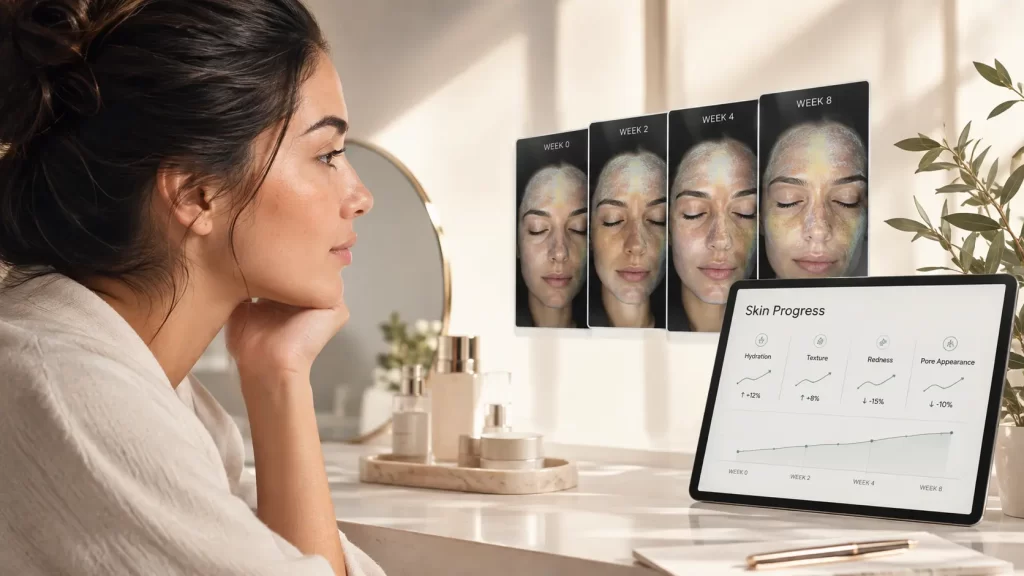
Imagine that you’ve started a new skincare routine.
After a week or two, you may look in the mirror and still not be able to tell whether anything has really changed.
Especially when the changes are gradual.
Small changes don’t always become obvious from one day to the next.
But when you have multiple Skin Scans taken at different points in time, you can follow those changes in a more organized way.
The goal isn’t to judge your skin based on a single day.
The goal is to see the bigger picture.
Progress Doesn’t Mean Your Skin Has to Be “Perfect”
This is an important point.
Tracking Progress doesn’t mean that every new result has to be better than the previous one.
Your skin naturally changes.
Some indicators may improve, while others may need more attention.
Your results can also be affected by different conditions at the time of each scan.
That’s why the real value of Progress is helping you understand changes and trends over time, rather than relying on a single moment or impression
What’s the Difference Between One Result and Progress?
Let’s make it simple.
If you perform a Skin Scan today, you can learn about your skin at that particular moment.
That’s one snapshot.
But if you scan your skin today, then perform another scan later, followed by a third one…
You now have multiple snapshots.
And when you look at them together, you can start to see the bigger picture.
Think of it as the difference between:
One picture and A complete story.
That’s what makes Progress valuable.
How Can You Make the Most of It?
If you use SkinTrix 360 consistently, you can make Progress part of the way you monitor your skin over time.
- Start With a Skin Scan
Analyze your skin and use the result as your starting point.
- Keep Tracking Your Skin
Instead of relying on a single analysis, perform additional scans at appropriate intervals to monitor changes.
- Review Your Results
Look at the differences between your various scan results.
- Focus on the Trend
Not every change needs to be significant.
Sometimes, what matters most is understanding how your skin is changing over time.
Your Skin Is More Than One Picture
Your skin is not one picture.
It’s not one result.
And it’s not just one day. It’s a journey.
As time passes, your skin’s needs can change.
That’s why tracking your Progress can help you understand that journey more clearly.
With SkinTrix 360, every Skin Scan can become another point in your skin-tracking journey.
Scan. Track your results. Follow your Progress.
Because sometimes, the changes we can’t notice every day…
become much clearer when we look at the bigger picture.